
The Conundrum of Building Roads to Wild Places does not provide a solution to the problem of trying to access wild places while concurrently trying to protect them from one’s own impact. It asks the viewer to question their daily impact on our environment.
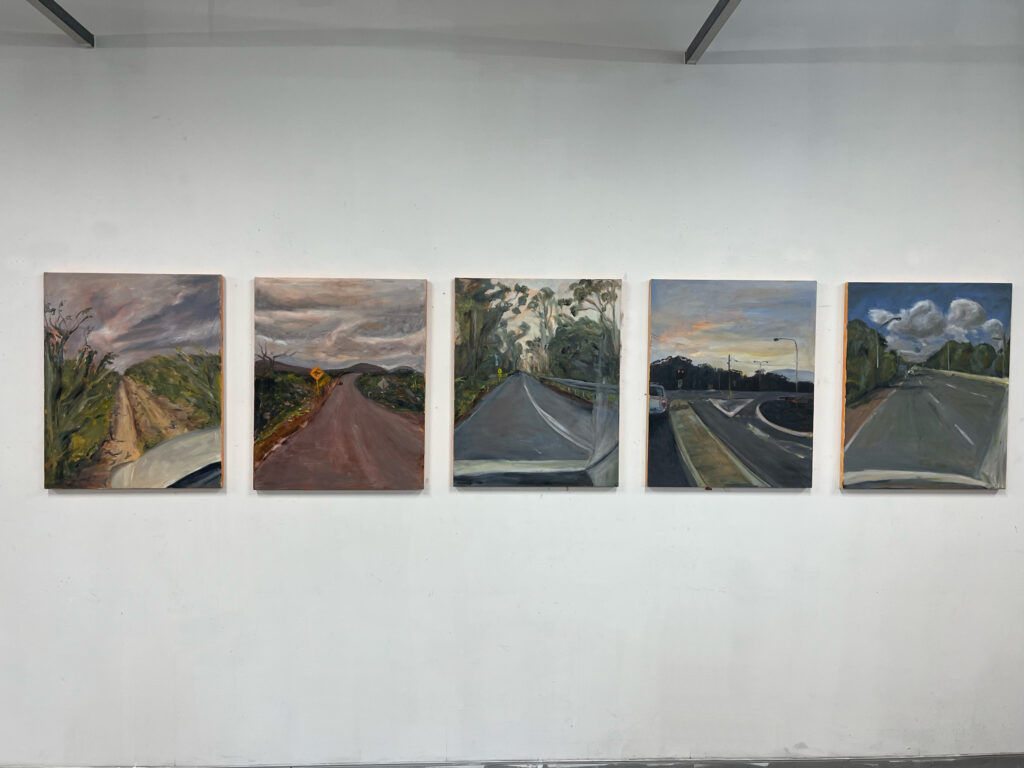
UWA Level 1 Gallery, October 2025.
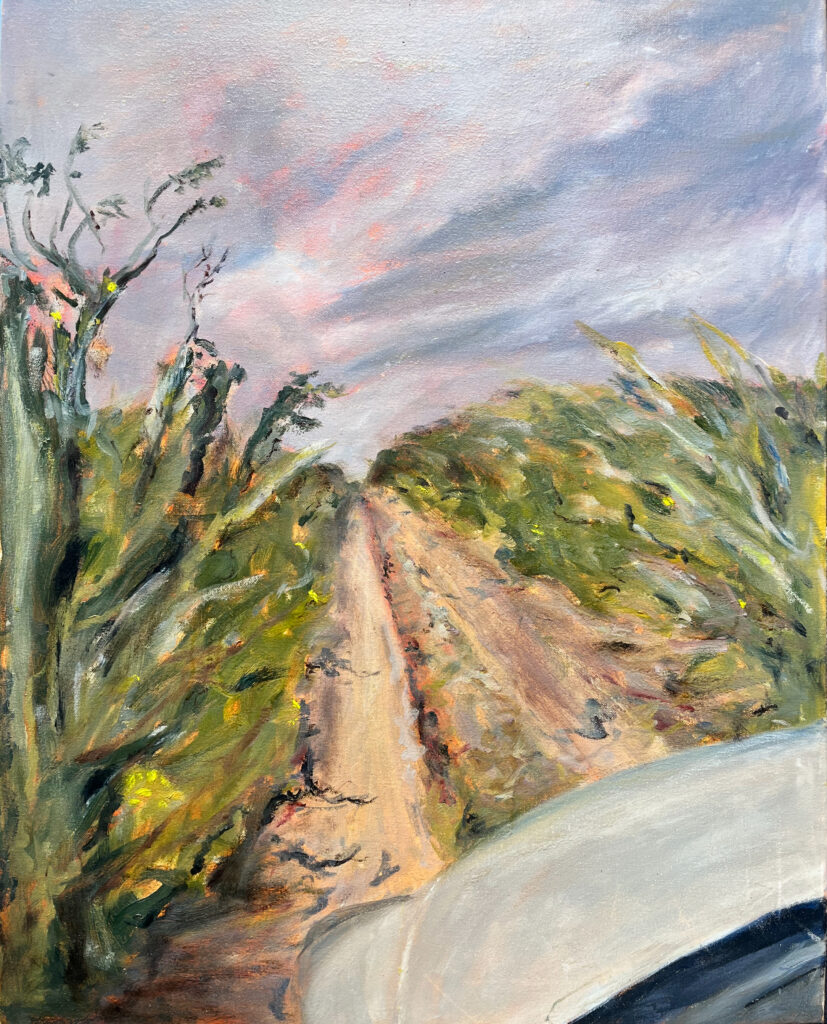
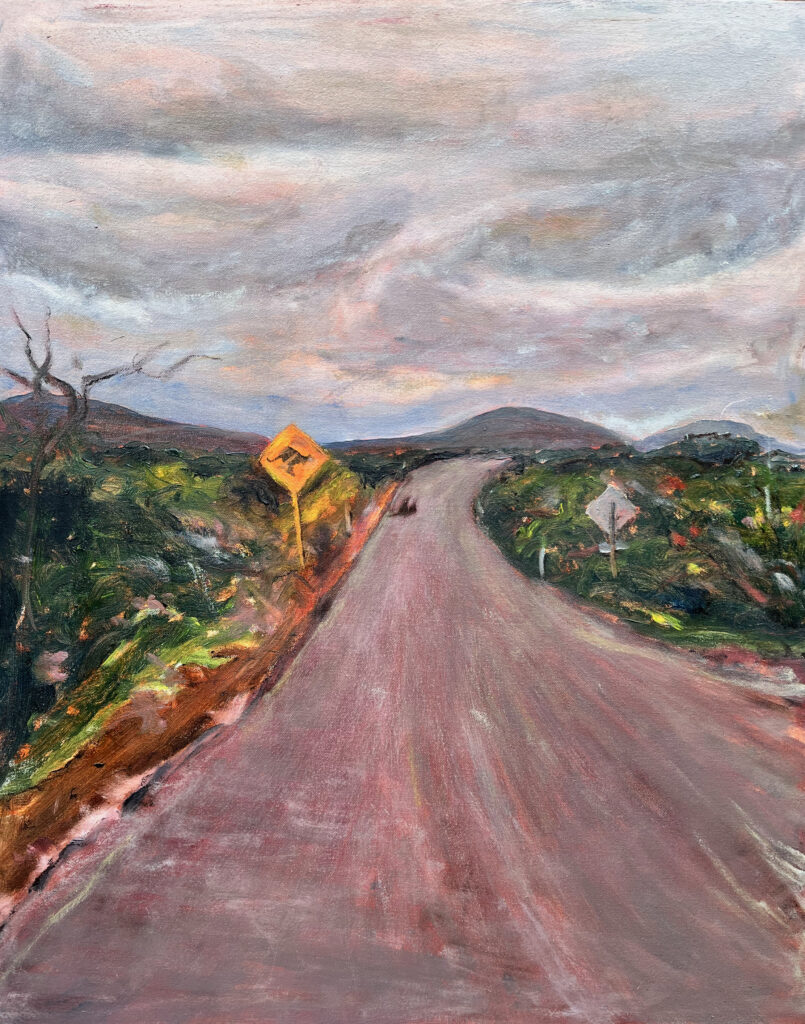
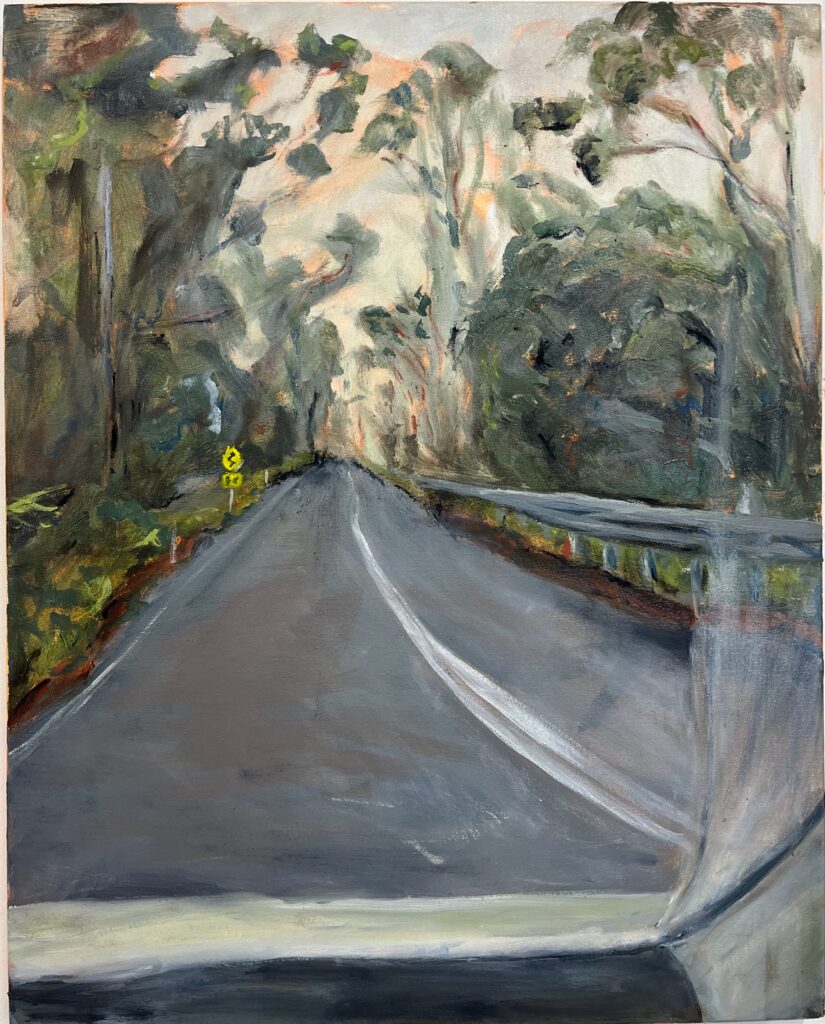
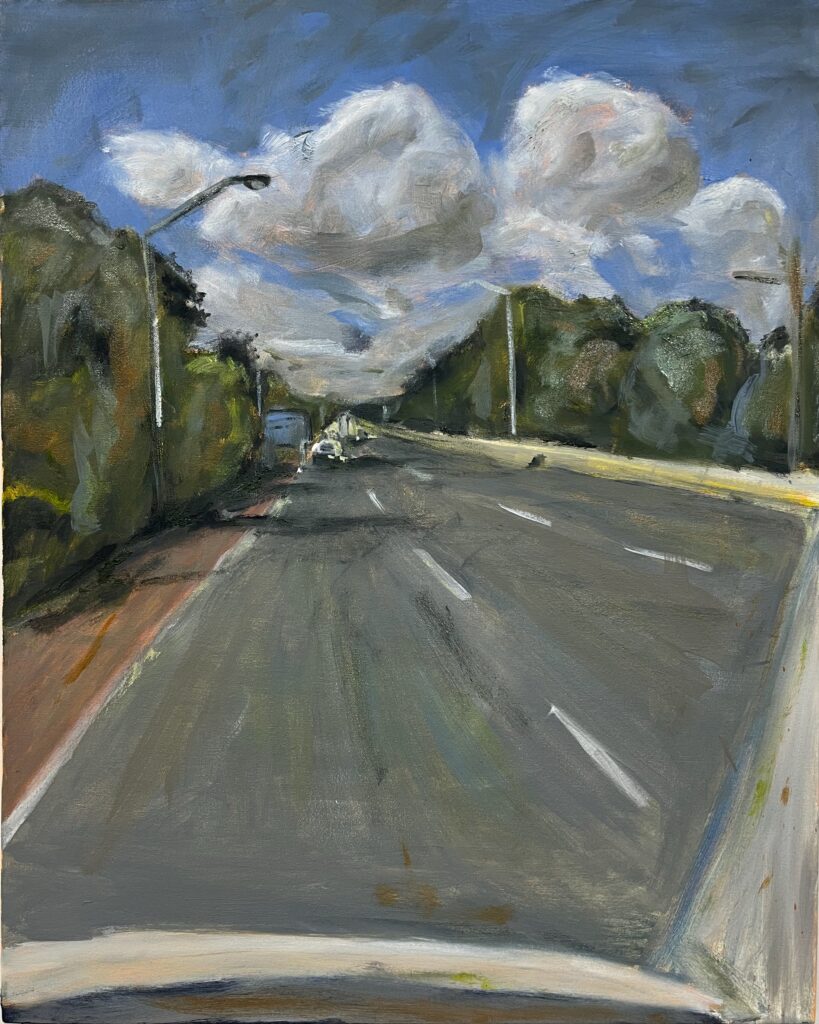
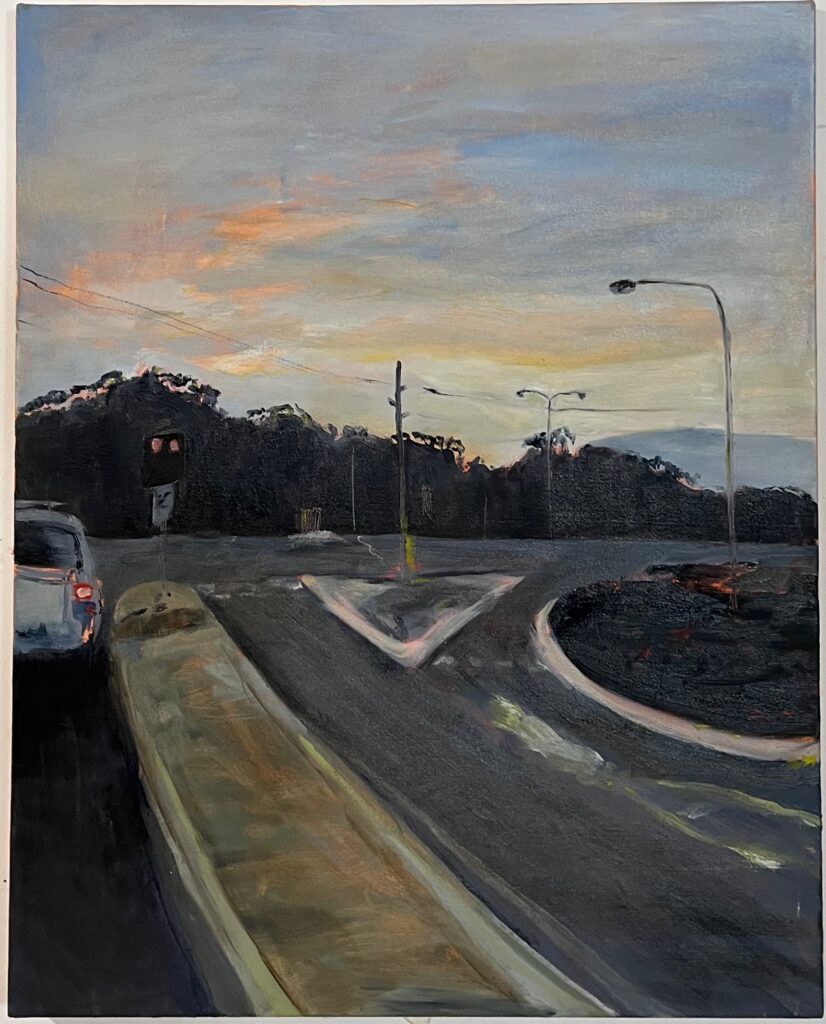
The Conundrum of Building Roads to Wild Places is a series of five oil paintings on canvas (76 x 61cm each) that considers the damage caused by the construction of roads to wild places. The name for each painting is derived from the flora that was compromised in the construction of each road. Each composition is inspired by places in Western Australia. Mallee-heath scrub is based on a road through the Fitzgerald National Park. Coastal Heath is based on the road to Wharton’s Beach near Esperance. Jarrah Forrest is inspired by roads near Denmark in the state’s south. Eucalyptus Forrest is based on an intersection near Midlands and Banksia is inspired by the Kwinana Freeway outside of Perth.
Western Australia has an abundance of wild places. At a time when biodiversity is at its lowest in human history, preservation of these unique areas is crucial. The Australian Threatened Species Index 2024 showed a 36-year abundance decline in threatened species (73%), amphibians (97%), plant species (68%), bird species (59%) and mammal species (45%)[1]. When a place is protected from development, there is an onus on the state government to justify the missed economic development potential by establishing national parks and ecotourism in the area. Roads are built to provide access. However, building roads leads to the destruction of the very ecosystem that is being protected. The evolving scientific field of road ecology studies the environmental impact of roads. Along with pollution, noise, animal mortality and the spread of damaging weeds, roads cause significant fragmentation of habitat. This destruction leads to genetic isolation of local flora and fauna[2]. While road ecology studies are increasing in popularity, evolutionary studies of changes caused by roads splitting habitats, is surprisingly falling behind in funding and activity[3]. The size and usage of a road, affects its environmental impact. Visible impacts to native environments are described as an “effect zone” that can extend as far as 100m from the road edge[4]. A four-wheel-drive track can provide access to an area. While only taking the width of a vehicle, these tracks can become dangerous and difficult to maintain, particularly with overuse and weather events. The environmental impact of the heavy, diesel-powered vehicles that are used on these tracks cannot be ignored and the onus is placed on the vehicle owner to ensure exotic seeds are not brought into an area on the car underbody. To accommodate for increased interest in an area, these tracks are expanded into graded, gravel roads that are at least three times the width of a single track. These roads become heavily corrugated with use, causing slippery road conditions. These roads require continual grading for road safety and to mimimise damage to vehicles caused by corrugations. Eventually, gravel roads are paved with bitumen-asphalt at great cost. Ease of access to an area brings a significant increase in visitor numbers, leading to the development of sewerage, water and rubbish removal. Ecotourism is vital to the economic survival of National Parks and welcomed by the thousands of visitors gaining positive experiences in a natural environment. Importantly, quality roads provide safe transportation to millions of Australians everyday. This minimises road trauma and the successive costs, both human and economic, into the future. However excessive development diminishes the wildness of a place and can be detrimental to the local flora and fauna. Roads are necessary, particularly in a vast state like Western Australia. But as someone who likes to visit wild places, one cannot help but feel a little guilty about the environmental cost of providing access to such places.
Road ecology is increasingly being considered in project management and there has been some progress in impact mitigation. The Wilman Wadandi Highway is a significant, four-lane road that connects the Forrest and Bussell Highways, south of Perth. In this project, wildlife protection measures include 14 rope bridges, 2 land bridges and 24 underpasses between extensive fences designed for fauna to safely cross to the other side of the highway[5]. These measures attempt to minimise fauna population isolation caused by roads but relies on the adaptation of species to utilize the fauna crossings provided and overcome natural road and noise avoidance.
Exploitation of wild areas for road development is not isolated to regional and remote places. One example of the loss of wild places in an urban environment is the extension of the Tonkin Highway in Perth’s east. This development was completed in response to an increased need for transport in the area but resulted in the destruction of local “green corridors”. In 2019, Main Roads WA conducted a survey of the area that found 490 trees including Jarrah, Marri and flooded gum, that were classified as nesting trees or potential breeding trees for the endangered Carnaby’s Cockatoo (Calyptorhynchus latirostris) and Baudin’s Cockatoo (Calyptorhynchus baudinii)[6]. While this report can no longer be found on the Main Roads website, it can still be located through a Google search. Despite this worrying assessment, the Tonkin Highway extension was approved with Main Roads WA providing “qualified fauna handlers onsite during clearing to safely relocate fauna”[7]. Unfortunately, the planting of banksias along the roadside of the new highway, have caused multiple birds to be hit by cars in 2025[8]. These perilous feeding habits are due to major clearing of 23,000 hectares at the Gnangara pines plantations north of Perth, despite WA State Government announcing a decision to cease logging the area in 2023[9].
In urban environments, the remaining green corridors of established trees in Perth are increasingly being cleared for road development in the context of population growth and sprawl. The Conundrum of Building Roads to Wild Places does not provide a solution to the problem of trying to access wild places while concurrently trying to protect them from one’s own impact. It asks the viewer to question their daily impact on our environment.
[1] Australian Bureau of Statistics, “Biological Diversity: Protect, repair and manage the environment”, 15 September 2025, https://www.abs.gov.au/statistics/measuring-what-matters/measuring-what-matters-themes-and-indicators/sustainable/biological-diversity.
[2] Lesley Evans Ogden, “Road Ecology: Reconnecting a Fragmented Landscape”, BioScience, Vol. 62. No. 1. (January 2012): 100. http://www.jstor.org/stable/10.1525/bio.2012.62.1.19.
[3] Steven P Brady and Jonathan L Richardson. “Road Ecology: shifting gears towards evolutionary perspectives”, Frontiers in Ecology and the Environment, Vol. 15. No. 2. (March 2017): 91. https://www.jstor.org/stable/44214715.
[4] John A Bissonette and Silvia A Rosa, “Road Zone Effects in Small-mammal Communities”, Ecology and Society, Vol. 14. No. 1. (June 2009): 13. https://www.jstor.org/stable/26268027.
[5] Mainroads Western Australia, “Wilman Wadandi Highway: The Bunbury Outer Ring Road Project”. Accessed 11 October, 2025. https://www.mainroads.wa.gov.au/48cd94/globalassets/projects-initiatives/projects/regional/bunbury-outer-ring-road/borr-project-flyer.pdf.
[6] Tony Kirkby, “Black Cockatoo breeding, feeding and roosting habitat assessment, Tonkin Highway Extension”, 2019, https://www.mainroads.wa.gov.au/4a4324/globalassets/projects-initiatives/projects/metro/tonkin-hwy-ext-thomas-rd-upgrade/environment/tonkin-highway-extension-referral-att-13-tonkin-hwy-black-cockatoo-assessment.pdf.
[7] Mainroads Western Australia, “Tonkin Highway Extension and Thomas Road Upgrade”, 8 October 2025. https://www.mainroads.wa.gov.au/projects-initiatives/all-projects/metropolitan/tonkin-highway-extension-and-thomas-road-upgrade/.
[8] Nadia Mitsopoulos, “Hungry cockatoos heading to Tonkin Highway for food”, ABC Radio Perth, 15 September 2025, https://www.facebook.com/photo/?fbid=1335667851555732&set=wildlife-rescuers-say-planting-banksias-on-the-median-strips-and-roadsides-areas.
[9] Government of Western Australia. “Cockatoo habitat preserved following Gnangara pines decision”, 13 December 2023. https://www.wa.gov.au/government/media-statements/Cook-Labor-Government/Cockatoo-habitat-preserved-following-Gnangara-pines-decision-20231213.
[10] Lydia Trethewey, “Artworks – 2016”, Accessed 9 September 2025, https://www.trethewey.id.au/index.php?page=p2016.